Situations design diary part 3: selecting words
The previous post in the Situations design diary series went over the various types of cards in the game: nouns, adjectives, Is A, and And. But that's just the beginning of developing the deck - I had to select words to put on the cards!
I had a few goals for the play experience:
- Easy to play cards
- The player should never feel like they're "stuck" and don't have a card that makes sense to play
- The player should feel like they have an interesting decision to make, but not an overwhelming amount of options
- Easy to write the stories
- The player should never feel like there's too little to go off of and they don't know where to start
- The player should never be overwhelmed by how many different things they have to include in their story
- The stories shouldn't come out identical. Players' ideas and interpretation should result in interesting differences between their stories
So how did I select a set of words that matched these goals?
Step 1: Find some words
I began by looking for well curated and interesting word lists. My jumping off point was resources that were suggested for creating Twitter bots - mainly Darius Kazemi's Corpora as well as other resources from Nora Reed's Botmaking Resources. I manually went through and picked words that I thought were interesting, until I had way more words than I needed for my target deck size. Then I made a spreadsheet.
Step 2: Make a spreadsheet
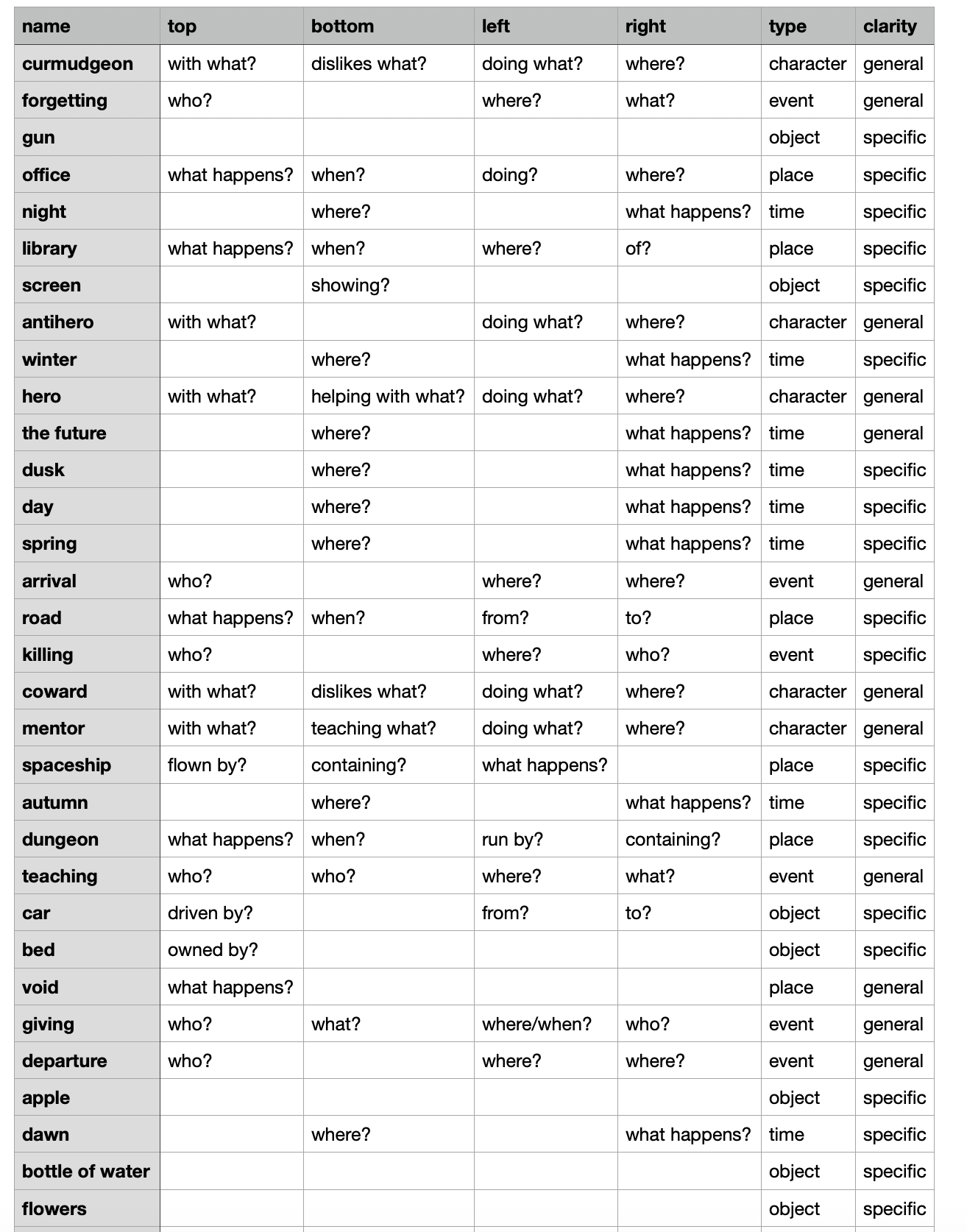
I put all the words in a spreadsheet, then added a bunch of columns. Top, bottom, left, and right are columns for the questions along the edges (If you're curious why there are so many blank spots, I talked about it here). I tried to both include the obvious questions that you'd ask, as well as some more unique questions that relate to the specific word in question.
The more interesting columns are on the right - "type" and "clarity." These were my main levers for balancing the deck to meet my goals. "Type" is what type of noun a word is - for example, a person, a place, an object, an event. "Clarity" is whether a word is "specific" or "general" - I'll explain what I meant by those in a moment. The basic idea here is that I could calculate the number of words in each category, and then balance them to try and have a proportional mix of each type and a proportional mix of each clarity, that I could then tune through playtesting. If you've ever done any TCG deckbuilding, this will probably sound pretty familiar.
Looking back on this, I'm surprised that I don't have a column for "genre" - I very intentionally made Situations genre-agnostic, so I attempted to have a mixture of words that would pin the situation to a particular genre and words that would work in a story of any genre. I guess I must have done this bit all in my head!
Types of types
The types that I identified were pretty straightforward - characters, places, times, events, and objects. I wanted every situation to typically have at least one character, at least one event, and some mixture of places, times, and objects. Situations without events and without characters are often very hard to write stories for - there's no jumping-off point.
Specific vs general
When I defined nouns as specific or general, this was in the sense of "does this make the setting or genre of the story more concrete, or does this fit any setting/genre?" For example, an office is "specific" - it implies that the story exists in a milieu containing offices, so perhaps a workplace drama or something of that nature, but definitely not a story about prehistoric hunter-gatherers. On the other hand, a curmudgeon can exist anywhere - it's "general." The idea is that if you have too few specific cards in the situation, then there's no jumping-off point for players. A situation with a curmudgeon teaching after a departure could be anything, and will lead to analysis paralysis. On the other hand, add in that the departure is "to an alien planet" and as they say, baby you've got a stew cooking.
Similarly, if you have too many specific cards, then writing a story becomes difficult because there are too many definite elements to include, and some of them may feel like they start to conflict. For example, a situation where a princess gives an apple at dawn and is killed by an orc on a spaceship also feels tricky to write - there are so many elements to remember to include.
Step 3: Playtest
Doing abstract spreadsheet math is a good first stab, but this is just a jumping-off point for actual playtesting. I did a lot of playtesting and took a lot of notes, focusing on cards that came out and cards that didn't get played and situations that people found easy to write vs difficult to write. I used these to tune a number of things:
Tuning the structure
There were several structural levers besides the word list itself that I could tune to dial in these issues: how many cards are in players' hands and how many cards they could play down before situation building ended and writing began. In terms of hand size, what I found was that a small hand size of five limited analysis paralysis.
My initial thought for ending the situation building phase and starting the writing phase was to give each player a fixed number of turns - for example, everyone plays twice and then writing begins. There were a couple problems with this - first of all, the amount of cards in the situation depended on the number of players in the game. With two players, two turns each led to too small of a situation to be easily writable, while with six players two turns each led to way too complicated of a situation!
I could tune this to something like "play until players have taken a total of X turns," but there would still be a problem: a situation where there were six played turns where each player played a noun card would usually be a pretty good situation for writing, but a situation where there were six played turns but four of them were used for playing adjectives would result in a situation without enough detail. Adjectives add color, but don't tend to have much of an impact on whether players find the situation easy or hard to write.
The solution I landed on was to end the playing phase when a certain number (six, in the published game) of noun cards are played. This has a few benefits:
- The size of the situation is fixed regardless of the number of players
- The complexity of the situation depends more on the number of nouns than the number of adjectives, so the complexity of the final situation is more predictable
- Players can control when to end situation building themselves - if there are already five noun cards out, players can keep it going by playing adjectives. This improves players' perception of fairness - their seat at the table doesn't necessarily determine how many times they get to play, because if they are excited to play a card the previous player could decide to extend situation building for them.
Tuning the cards
Because I had a spreadsheet with numbers of cards in different categories - specific cards, vague cards, people, places, things, and so on - if I noticed a trend like players not having enough events or having too many places, I could easily adjust my cutoffs, adding a few events that had been below the cut line or removing some of the places. Similarly if the situations had too many clashing details I could increase the proportion of general cards, while if the situations didn't feel like they had anything concrete for players to start with, I could increase the proportion of specific cards.
I also did a lot of tuning of specific cards. I noted down cards that were interesting and cards that were uninteresting, cards that players liked to play and cards that tended to sit in players' hands. I basically removed any card that tended to sit in players' hands or have uninteresting results when played.
Here are some examples of words that I removed:
- screen - I intended this to be a display screen, but it's a very ambiguous word. This meant that players often didn't play it.
- bottle of water - a character interacting with a bottle of water says very little about them, so playing this card tends to have very little effect on the final stories.
- imagining - while evocative, a character imagining something implies that it didn't actually happen. That means that it takes up space in the situation that could be occupied with a more impactful event, so it ends up contributing to lots of situations that don't have enough events to easily write.
Here are some examples of words that I added to replace them:
- representative - similar to a screen, a representative is quite vague. But even though there are many kinds of representatives, they have a fairly understandable role in a story, and by connecting up questions like "of what," players can use this card very flexibly in terms of specific content. In other words, the flexibility is an asset here, whereas for screen it's a liability.
- rose - roses have lots of strong associations. Giving a character a rose can have all kinds of rich meanings that players can mine, which makes it much more impactful on the final stories than a bottle of water.
- coming-of-age - a coming of age is a classic centerpiece to a plot. Adding a coming of age instantly evokes certain types of obstacles and challenges that are ripe for players jumping off into writing interesting stories. One card adds a lot of structure to the situation, whereas with imagining one card takes up space that could be used to add structure.
Previous post: the different types of cards in Situations
The next post will be about the visual style of Situations - why does it look like that? Stay tuned!