Situations design diary 1: Inventing Situations
"Judy's in the bedroom, inventing situations \ Bob is on the street today, scouting up locations \ They've enlisted all their family. They've enlisted all their friends \ It helped save their relationship \ And made it work again" - Talking Heads, Found a Job
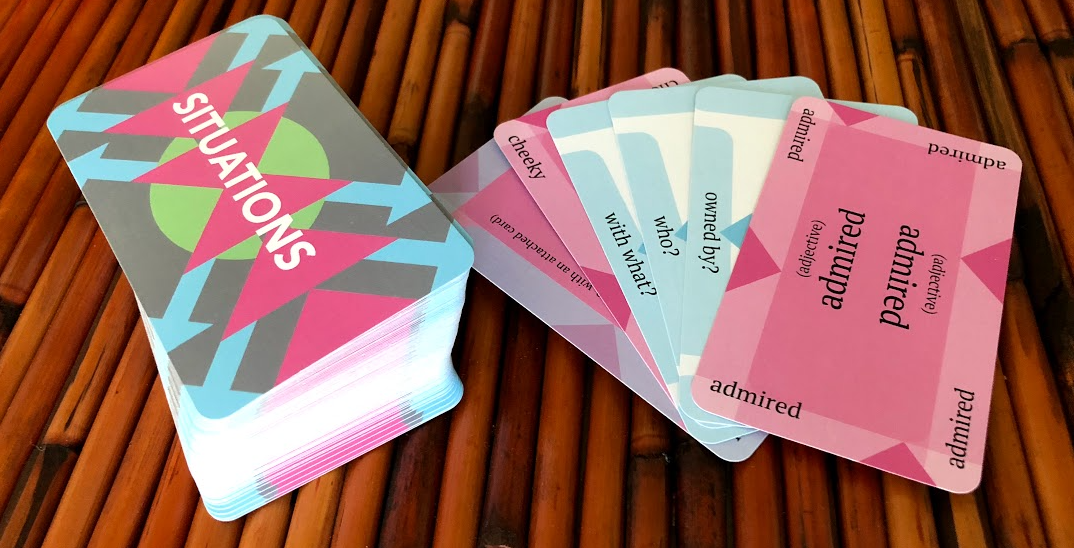
Welcome to my series where I discuss the design of my game Situations, a card game where players build up a shared "situation" by playing cards, and then each player writes their own piece of flash fiction that interprets the situation into a story. I began working on it in 2017 and it went out to Kickstarter backers in 2019.
I first started creating Situations for an interaction design project my senior year of college where we were asked to design a game. At that time, I was very into the Twitter bot scene, which had a large overlap with the Twitter sphere surrounding procedural content generation (the field of study of creating algorithmic art generators, pre-AI. If the idea of relating this field to TTRPGs interests you, I have an article coming up in Playtest Material on this topic - stay tuned). While casting about for an idea for the project, I saw a post from Kate Compton, one of the most prominent voices in that sphere, advertising her Kickstarter for Generominos.
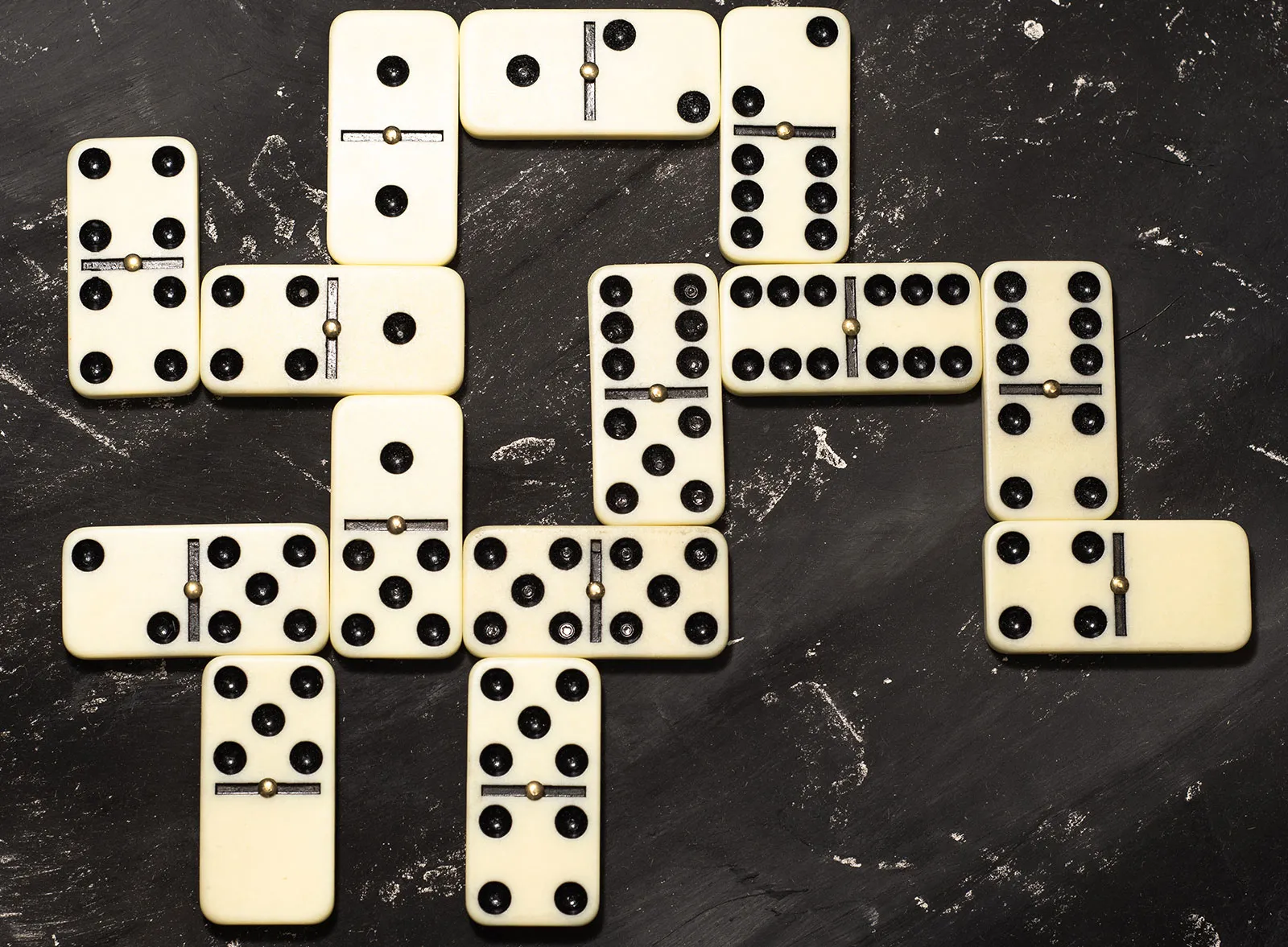
I'd recently been taught to play Dominoes by a summer roommate from Jamaica (IYKYK), and the name "Generominos" evoked something that used the matching mechanic of dominoes in order to generate something. I figured that the way this ought to work is that each "domino" (or card, since manufacturing dominoes is not easy) would have a concept on it, and then they would be able to be matched if they had a relationship that they could share. For example, if one card has "woman" and another has "dog," they could connect - the dog would be the woman's pet, and the woman would be the dog's owner.
(This is not really related to Kate Compton's Generominos at all - her Generominos are cards for inspiring you to create generators, and cards have computer operations that can be connected output to input. But I never actually clicked the link, so I didn't find out how they actually worked until after I had finished designing Situations)
The Structure of Situations
Having the idea of constructing a scenario collaboratively by playing domino-like cards, the next question that arises is "what do you actually do with this?" What is interesting about this? How does this become a game?
A game of Situations consists of 4 parts:
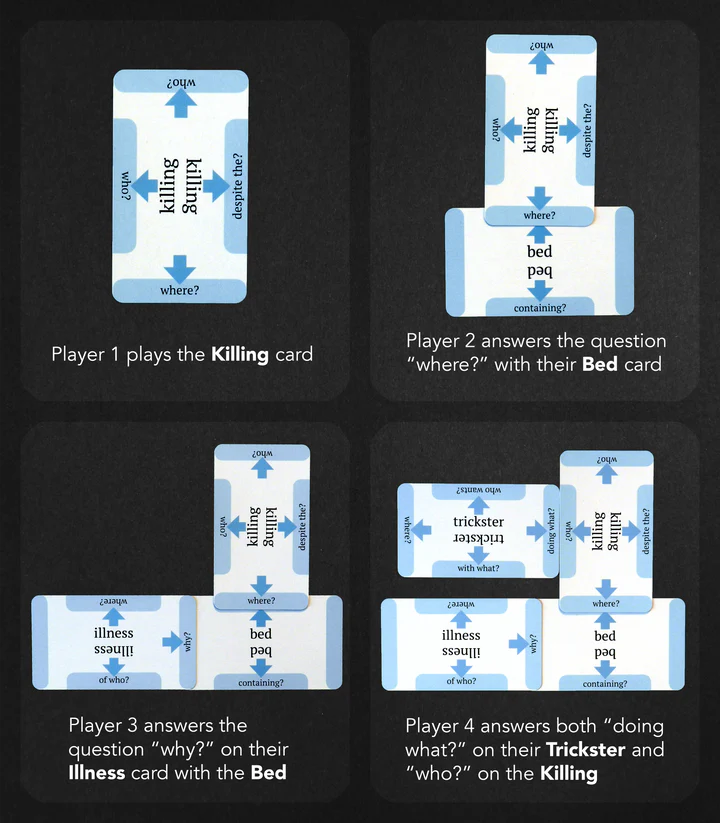
1) Players are dealt hands of cards and go around the table playing the cards and connecting them to each other to create a web of objects, events, and adjectives connected by relationships - the situation
2) Players are each given a small piece of paper, and have to write a piece of flash fiction based on the situation
3) Players randomly shuffle up the stories and each player reads a random story out loud
4) Players vote on which story they like the most
Step 1: Building the Situation
A lot of my inspiration for the game came from reading I'd done on procedural generation and Twitter bots. One of the most influential pieces of writing on Situations was Kate Compton's essay So You Want To Build A Generator, in particular the section on "why generation fails."
According to Kate Compton, the most common way that generators fail is that the generated content "fails to be interesting." She claims this is the most common way that generators fail, and gives this the name "the Ten Thousand Bowls of Oatmeal Problem." This problem definition has become used very widely. Here's how she describes it:
So your algorithm may generate 18,446,744,073,709,551,616 planets. They may each be subtly different, but as they player is exploring them rapidly, will they be perceived as different? I like to call this problem the 10,000 Bowls of Oatmeal problem. I can easily generate 10,000 bowls of plain oatmeal, with each oat being in a different position and different orientation, and mathematically speaking they will all be completely unique. But the user will likely just see a lot of oatmeal. Perceptual uniqueness is the real metric, and it’s darn tough.
For digital generators, the suggestion she gives is to focus on having your generator potentially be able to generate some percentage of "characterful" artifacts, and then generate in large quantities.
"Many artifacts can be drab background noise, highlighting the few characterful artifacts"
Basically, viewers will identify from a lineup of many possibilities which ones are actually interesting, and ignore the ones that are not. A digital generator can generate a large lineup like this. But thinking of Situations as a generator, it has an advantage that these digital generators don't have - players can choose a card from their hand that bends the situation in the direction of characterfulness.
Kate Compton includes some guesses in her blog post as to what often makes generated artifacts characterful:
Characterful artifacts is another blog post for another time, but certain aesthetic principles create objects with readable meanings for human perception. Humans seem to like perceiving evidence of process and forces, like the pushed up soil at the base of a tree, or the grass growing in the shelter of a gravestone. These structurally-generated subtleties suggest to us that there is an alive world behind this object. Kevin Lynch’s influential “Image of the City” demonstrates that there are factors that make cities memorable and describable. Perhaps there are other aesthetic rules that we can discover, too.
Step 2: Writing
The idea of having a writing step after the situation-building step also came out of the Twitter bot world. Nora Reed, an influential Twitter bot creator, wrote a really great Twitter thread that was a big inspiration that I loved to cite here. Unfortunately they deleted their Twitter for obvious reasons so it's gone forever, except for the first three tweets which were preserved on archive.org, so you'll have to bear with my foggy memories here a bit.
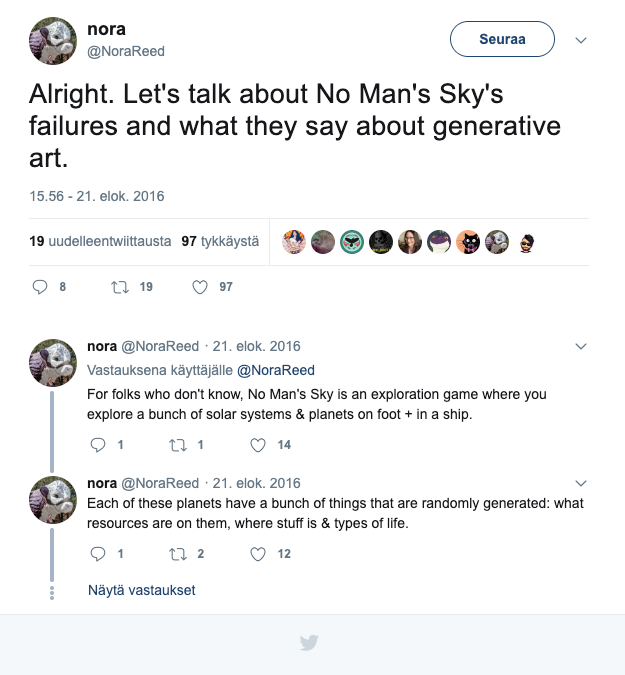
The main point they made in this thread was that the way that people get value out of procedurally generated content is by expanding on it in their head in order to create a larger story. This can happen if the content references other things or has a coherent narrative behind it that the player can imagine. By having the procedurally generated content be open-ended, it invites viewers in to try and construct what the references or narratives behind it might be, which encourages viewer interest. (I reached out to Nora to see if they had a copy of this thread, and when I talked about this point, they said that they "vaguely remember that" - funny how these things go)
This is the core logic behind the structure of Situations. In the first half of the game, players build something that might feel a little bit random. The second half of the game is writing - players write a piece of flash fiction based on what was constructed in the first half. This encourages players to identify a structure behind the generated content. Players discuss how they think a card will be interpreted as it is played - and then when it's time to write, players put their money where their mouth is and actually do the interpreting. Inevitably, different players have very different interpretations. The stories created out of one game of Situations tend to vary wildly in tone and content, even though they began from the same seed.
Writing flash fiction with no time limit
One rule that players often don't expect is that there is no time limit for writing in Situations. Intuitively, something like a sand timer would make sense to keep players from overthinking things. I decided this wasn't necessary because different play groups will have different norms around how much time they want to spend on their writing. No need to interrupt everyone early if everyone is having fun! Instead, Situations encourages players to socially pressure anyone who's taking way longer than anyone else, which sounds like a silly rule but in practice this works quite well, because the small paper that players are writing on acts as a limit against people doing too much writing anyways.

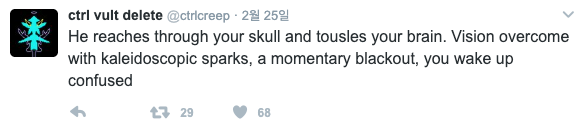
The type of shit I was OBSESSED with in 2018
Using a small piece of paper as the limit is also inspired by a Twitter scene of that era - the Twitter microfiction scene. Writers in this scene, like Uel Aramchek (who's back! Check out his new stuff) and ctrlcreep were able to do incredible things in 140 and later 280 characters. The restriction of the paper in Situations puts the story length closer to flash fiction than microfiction, but microfiction is where the idea came from.
Steps 3 and 4: Reading and Voting
The final part of a game of Situations is reading and then voting on a winner. This is the part of the design that with the benefit of hindsight I feel is weakest. Because I mentally was categorizing Situations as a board game during the time I was designing it, it seemed obvious that voting on the best story would be a natural way to finish a round - 2018 was firmly in the Cards Against Humanity era and many popular games included a similar voting mechanic.
I didn't think players should read their own stories - that would make it clear who wrote what and allow players to vote along personal lines rather than for what the actual best story was. I was also very worried that players would feel shy about their writing and not want to share. To address this, the rules state that players should shuffle up the stories and randomly read each other's.
While this can be kind of fun, often this results in snags due to players' being dealt their own stories (the rulebook makes clear that if you don't say anything nobody will know it's your own story! But that's not necessarily obvious), and then figuring out each other's handwriting. Often players will need the original writer to clarify some particularly hard to read section, at which point the anonymity is gone anyways.
In hindsight, the whole idea of a winner probably wasn't necessary at all. If there are future editions, I plan to lean more into the tabletop roleplaying game-adjacent nature of Situations and demote the voting and winning mechanic to an optional rule. Determining the winner isn't really the important part of this game!
I hope you found this discussion of some of my inspirations interesting. Stay tuned for part 2 of this series, where I'll discuss the various kinds of cards in the Situations deck and the thinking behind them!